RSS

Category Archives: Published Baseball Writing

Willie Mays’ Missing MVP Awards

Willie Mays passed away on Tuesday at the age of 93. In his honor, I’m returning to the interwebs this piece I wrote about his greatness for Sports on Earth on the occasion of Mays’ 86th birthday in May 2017. Note that, for the statistics included in the headers below, league-leading totals are in bold and major-league leading totals are in bold and italics. Advanced statistic calculations all date to May 2017.

Willie Mays turned 86 on Saturday. Mays is arguably the greatest living baseball player, and, in the minds of some, the greatest player who ever lived. However, as his career continues to recede into the past, I have a growing sense that the enormity of his greatness is underappreciated. I believe there are several reasons for this. His contributions in the field and on the bases are difficult to properly quantify, the ballparks and era in which he played suppressed his hitting and baserunning statistics, his Giants teams only made it to one World Series, which they lost, after his age-23 season, and the era’s MVP voters repeatedly undervalued his performances, that last likely due in part to the previous two.

Over a 13-season span from 1954 to 1966, Mays hit .315/.390/.601 (166 OPS+) while averaging 40 home runs, 109 RBI, 117 runs scored, 21 steals, nine triples, and 9.5 wins above replacement (Baseball-Reference version, or bWAR) per season. That’s an MVP-level performance, which Mays sustained over 13 seasons (by way of comparison, last year’s NL MVP winner, Kris Bryant, posted a 150 OPS+ and 7.7 bWAR). How is it possible that Mays only won the award twice over that span? How many times in those 13 seasons did a deserving Mays season go unrewarded? To find the answer, let’s take a quick look at each season in turn.

1954

Mays: .345/.411/.667 (173 wRC+), 41 HR, 110 RBI, 119 R, 13 3B, 10.6 bWAR

MVP: Mays

After spending most of 1952 and all of 1953 in the Army, Mays returned to the Giants for his age-23 season and led New York to 97 wins and the pennant and, after the votes were submitted, a four-game sweep of the 111-win Indians in a World Series best remembered for his catch of Vic Wertz’ 440-foot fly ball in the Polo Grounds.

Who should have won: Mays

1955

Mays: .319/.400/.659 (172 wRC+), 51 HR, 127 RBI, 123 R, 13 3B, 24 SB (86%), 9.0 bWAR

MVP: Roy Campanella, C, Dodgers – .318/.395/.583 (150 wRC+), 32 HR, 107 RBI, 81 R, 5.2 bWAR

Also: Duke Snider, CF, Dodgers – .309/.418/.628 (164 wRC+), 42 HR, 136 RBI, 126 R, 8.6 bWAR

Campanella won his third and final MVP award for a Dodgers team that won the NL pennant by 13 1/2 games. Mays’ Giants finished third at 80-74, 18 1/2 games back. However, per bWAR, Campanella was the third-most-valuable Dodger that year, behind Snider and ace lefty Don Newcombe (who hit .357/.395/.632 to boost his overall bWAR to 5.3). Snider and Campy both got eight first-place votes, but Campanella won the award with 226 overall points to Snider’s 221. Campy clearly got extra credit for his catching, which is not inappropriate as bWAR doesn’t capture the impact of framing. Still, even if you credit him two extra wins for framing, which is typically a lead-leaguing figure, he falls well short of Mays and Snider, both of whom were excellent fielders in their own right. Snider comes closer, but Mays, who finished fourth in the voting without a single first-place tally, was again the league’s best, and most valuable, player.

Who should have won: Mays

1956

Mays: .296/.369/.557 (143 wRC+), 36 HR, 84 RBI, 101 R, 40 SB (80%), 7.6 bWAR

MVP: Don Newcombe, LHP, Dodgers – 27-7, 3.06 ERA (131 ERA+), 0.99 WHIP, 3.02 K/BB, 268 IP (5.4 bWAR)

Also: Duke Snider, CF, Dodgers – .292/.399/.598 (156 wRC+), 43 HR, 101 RBI, 91 R, 7.6 bWAR

The Dodgers won the pennant again, the Giants sank to sixth place with an 67-87 record, and Newcombe, who didn’t contribute nearly as much with his bat this season, won both the MVP and the first ever Cy Young award, primarily because of that outstanding 27-7 record. Snider finished tenth with just one first-place vote. Mays finished 17th with none. Both should have fared better, but it was the Duke who wuz robbed this time.

Who should have won: Snider

1957

Mays: .333/.407/.626 (170 wRC+), 35 HR, 97 RBI, 112 R, 20 3B, 38 SB (67%), 8.3 bWAR

MVP: Hank Aaron, RF/CF, Braves – .322/.378/.600 (164 wRC+), 44 HR, 132 RBI, 118 R, 8.0 bWAR

With the Giants still languishing in sixth place, the Braves won their first pennant in nine years with the 23-year-old Aaron putting up outstanding triple-crown numbers and making 69 starts in center. Meanwhile, Mays’ Major League-leading stolen base total was undermined by 19 times caught stealing. Still, Mays was both the better fielder and, per on-base percentage, slugging and the park-adjusted wRC+, the better hitter. By virtue of appearing second on most Mays ballots, Aaron might still win this one if it were held today, but Mays, who finished fourth with just one first-place, was the more valuable player.

Who should have won: Mays

1958

Mays: .347/.419/.583 (162 wRC+), 29 HR, 96 RBI, 121 R, 31 SB (84%), 10.2 bWAR

MVP: Ernie Banks, SS, Cubs – .313/.366/.614 (151 wRC+), 47 HR, 129 RBI, 119 R, 11 3B, 9.4 bWAR

The Giants won eight more games than the Cubs in 1958, but MVP voters were more concerned about triple-crown stats than on-base percentage and park factors. The latter of those take on increasing significance in this study with the Giants’ move to San Francisco, though they wouldn’t move into Candlestick Park until 1960, playing their first two west-coast season in the Pacific Coast League’s Seals Stadium. In this case, Mays’ 53-point advantage in OBP, park-adjusted slugging, and the improvement in his stolen base efficiency rendered him even more valuable than a slick-fielding shortstop who clubbed 47 home runs. However, just three voters agreed in 1958 and Mays finished second in the balloting.

Who should have won: Mays

1959

Mays: .313/.381/.555 (152 wRC+), 34 HR, 104 RBI, 125 R, 27 SB (87%), 7.8 bWAR

MVP: Ernie Banks, SS, Cubs – .304/.374/.596 (147 wRC+), 45 HR, 143 RBI, 97 R, 10.2 bWAR

Also: Hank Aaron, RF, Braves – .355/.401/.636 (175 wRC+), 39 HR, 123 RBI, 116 R, 223 H, 8.6 bWAR

The Braves and Giants finished second and third, respectively, while Aaron was the best hitter in the majors. Banks, however, drove in more runs than any National Leaguer in 22 years setting a still-extant record for most RBI by an NL shortstop. Ironically, while that would make him appear to be an old-school choice, Total Zone rates him as having been 3.5 wins above replacement in the field, a suspiciously high evaluation given the limited accuracy of defensive stats, particularly when applied retroactively. Great as Banks was, I favor Aaron (who also stole eight bases in eight attempts and finished third in the voting) this year, but no matter which one of those two you prefer, the important point for our purposes here is that this was one year Mays, who finished sixth, was not robbed of the MVP.

Who should have won: Aaron

1960

Mays: .319/.381/.555 (155 wRC+), 29 HR, 103 RBI, 107 R, 12 3B, 25 SB (71%), 9.5 bWAR

MVP: Dick Groat, SS, Pirates – .325/.371/.394 (116 wRC+), 2 HR, 50 RBI, 85 R, 6.2 bWAR

Also: Hank Aaron, RF, Braves – .292/.352/.566 (150 wRC+), 40 HR, 126 RBI, 102 R, 11 3B, 16 SB (70%), 8.0 bWAR

Groat was a slick-fielding shortstop who won the batting title for pennant winner, but he wasn’t the same class of player as Mays (who led the league in hits and trailed Groat by just six points of batting average) or Aaron, in this season or any other. The Braves finished second, seven games behind Groat’s Pirates. The Giants were back in fifth place at 79-75. As in 1957, I could understand Aaron winning this one, but Mays, by virtue of his edge in on-base percentage, as well as on the bases and in the field, was still the better, and thus more valuable, player. Amazingly, neither Aaron nor Mays received a single first-place vote. Mays finished third in the voting, Aaron an inexplicable 11th.

Who should have won: Mays

1961

Mays: .308/.393/.584 (156 wRC+), 40 HR, 123 RBI, 129 R, 18 SB (67%), 8.7 bWAR

MVP: Frank Robinson, RF/LF, Reds – .323/.404/.611 (156 wRC+), 37 HR, 124 RBI, 117 R, 22 SB (88%), 7.7 bWAR

Also: Hank Aaron, CF/RF, Braves – .327/.381/.594 (153 wRC+), 34 HR, 120 RBI, 115 R, 10 3B, 21 SB (70%), 9.4 bWAR

Mays, Aaron and Robinson were of roughly identical value at the plate in 1961, while Robinson was the one that played for the pennant winner (the Giants finished third, the Braves fourth) and, surprisingly, was the most efficient and prolific basestealer. However, he was also the least impactful fielder. Aaron started 80 games in center and turned in his best defensive season per Total Zone Rating, but, unlike the previous three seasons, did not win a Gold Glove, which Mays did. I’m not sure there’s a wrong answer among these three, which makes it difficult to argue that Mays wuz robbed, but all else effectively being equal, Mays being a full-time center fielder, and an elite defensive one at that, breaks the tie for me. Amazingly, again, neither Mays nor Aaron received a first-place vote, finishing sixth and eight, respectively.

Who should have won: Mays

1962

Mays: .304/.384/.615 (163 wRC+), 49 HR, 141 RBI, 130 R, 18 SB (90%), 10.5 bWAR

MVP: Maury Wills, SS, Dodgers – .299/.347/.373 (103 wRC+), 6 HR, 48 RBI, 130 R, 10 3B, 104 SB (76%), 6.0 bWAR

Also: Frank Robinson, RF, Reds – .342/.421/.624 (171 wRC+), 39 HR, 136 RBI, 134 R, 51 2B, 18 SB (67%), 8.7 bWAR

The Dodgers and Giants had to play a three-game playoff to decide the pennant, with San Francisco emerging victorious in the third and final game. The MVP vote was nearly as close, with Wills, who set the single-season stolen base record, getting eight first-place votes to Mays’ seven and winning 209 points to 202. Transformative as Wills’ season was, Mays was clearly far more valuable. Robinson, who was as valuable as Mays at the plate but simply didn’t measure up in the field, finished fourth with two first-place votes.

Who should have won: Mays

1963

Mays: .314/.380/.582 (174 wRC+), 38 HR, 103 RBI, 115 R, 10.6 bWAR

MVP: Sandy Koufax, LHP, Dodgers – 25-5, 306 K, 1.88 ERA (159 ERA+), 0.88 WHIP, 5.28 K/BB, 11 SHO, 311 IP, 9.9 bWAR

Hank Aaron (178 wRC+) had a better season at the plate and on the bases (31-for-36 in steals) than Mays (8-for-11). Meanwhile, Cubs’ lefty Dick Ellsworth led the league in ERA+ (167) having posted a 2.11 ERA while pitching his home games in the far-less-pitcher-friendly confines of Wrigley Field, effectively tying Koufax with a 10.0 bWAR. However, Ellsworth was far more reliant on his defense. Koufax’s dominance was justly rewarded not only with the MVP (via 14 of the 20 first-place votes) but as the unanimous Cy Young award winner at a time when there was still just one award for both leagues. Aaron finished third in the MVP voting with one first place vote, Mays finished fifth with none. Ellsworth finished tied for 19th.

Who should have won: Koufax

1964

Mays: .296/.383/.607 (173 wRC+), 47 HR, 111 RBI, 121 R, 19 SB (79%), 11.0 bWAR

MVP: Ken Boyer, 3B, Cardinals – .295/.365/.489 (130 wRC+), 24 HR, 119 RBI, 100 R, 10 3B, 6.1 bWAR

Boyer was a respected, slick-fielding veteran who led the Majors in RBI for a pennant winner, and he did lead the Cardinals in bWAR, though one could argue the late-arriving Lou Brock was St. Louis’s most valuable player in 1964. However, in that wild year in which the top five teams in the league finished within five games on one another, the final standings should have been more irrelevant than ever. Mays’ Giants finished just three games behind the Cardinals, and Mays was far and away the league’s best player that year. What’s more, with the Giants three games out with four left to play, Mays went 8-for-16 with three homers, two doubles and just one strikeout to finish the year. Nonetheless, he didn’t receive a single first-place vote. Of all of the times Mays was robbed of the MVP, this was the most egregious.

Who should have won: Mays

1965

Mays: .317/.398/.645 (186 wRC+), 52 HR, 112 RBI, 118 R, 11.2 bWAR

MVP: Mays

The Giants finished two games behind the pennant-winning Dodgers thanks in part to the best statistical season of Mays’ career. Despite being 34 years old, Mays set career highs in bWAR, wRC+, and home runs, won his ninth of 12 straight Gold Gloves, and edged out Koufax to finally win his second, and final, MVP award.

Who should have won: Mays

1966

Mays: .288/.368/.556 (151 wRC+), 37 HR 103 RBI, 99 R, 9.0 bWAR

MVP: Roberto Clemente, RF, Pirates – .317/.360/.536 (143 wRC+), 29 HR, 119 RBI, 105 R, 11 3B, 8.2 bWAR

Also: Sandy Koufax, LHP, Dodgers – 27-9, 317 K, 1.73 ERA (190 ERA+), 0.99 WHIP, 4.12 K/BB, 27 CG, 5 SHO, 323 IP, 9.8 bWAR

The Dodgers, Giants and Pirates finished in that order atop the NL, with the Giants just one game out of first place in the loss column. Again, Mays didn’t receive a single first place vote, though he did finish third in the voting behind Clemente, who had the higher batting average and more RBI, and Koufax, who actually led in first-place votes, nine to Clemente’s eight. However, Clemente won the overall vote 218 to 208. Koufax would retire that November.

Who should have won: Koufax

Beyond the number of times Mays was stiffed, it’s alarming to note that the NL MVP voters gave the award to the right player just three times in these 13 seasons, two of those being the two awards Mays did win. Beyond those two awards in 1954 and 1965, however, Mays should also have won in 1955, 1957, 1958, 1960, 1961, 1962 and 1964. That’s seven MVPs he should have won but didn’t, which would have taken his career total to an unprecedented nine MVP trophies, two more than godson Barry Bonds’ current record. It’s also nine league MVPs in a 12-year span at a time when other all-time greats such as Hank Aaron and Frank Robinson were also enjoying their peak seasons in his league. As highly regarded as Mays is, I’m not sure many of today’s fans appreciate just how great or how consistent Mays was or the fact that he had an uninterrupted 13-year peak. To put that in context, Mike Trout would have to sustain his established level of greatness for the remainder of this season plus seven more to equal what Mays did in the heart of his career, and those are only the best 13 of Mays’ 22 Major League seasons.
 

Tags: , , , , , , , , , , , , ,

Judge & Stanton: “I feel sorry for the baseballs.”

My latest article at Baseball Prospectus draws numerous comparisons between Aaron Judge and the man whose American League home-run record he broke last year, Roger Maris. In my research for that piece, I dug up an article I wrote for Sports on Earth when the Yankees acquired Giancarlo Stanton in December 2017. Sports on Earth, along with the roughly 175 articles I wrote for it from September 2016 to January 2018, has been completely scrubbed from the internet, as best I can tell, so here’s another of those restored (from my unedited draft, as usual) for your reading pleasure. Worth noting: As of the 2023 season, Judge and Stanton’s highest combined home-run total as teammates was 93 in 2022, but the Yankees did break the single-season team record for home runs in 2018, although they went about it a bit differently than I predicted.

Giancarlo Stanton was officially introduced as a New York Yankee Monday afternoon, but even before he donned his number-27 pinstriped jersey, he made history. Stanton is just the third player in Major League history to be traded in the same offseason that he won his league’s Most Valuable Player award, as well as the third ever to be traded following a 50-home-run season*. As such, he is one of the most impressive acquisitions in the game’s history. What makes his move to the Yankees most compelling, however, is the history he has the potential to make going forward in combination with his new teammate/doppelganger, Aaron Judge.

*Philadelphia Athletics owner Connie Mack sold second baseman Eddie Collins to the White Sox after Collins’ 1914 MVP win; Alex Rodriguez was traded from the Rangers to the Yankees after his 2003 MVP season; Greg Vaughn was traded from the Padres to the Reds after hitting 50 home runs in 1998; Mark McGwire was traded from the A’s to the Cardinals at the 1997 non-wavier deadline following a 52-homer season and in the middle of a 58-homer season.

Stanton and Judge have already made history, or will come Opening Day. That’s when they will take the field as the just the second pair of teammates to both be coming off seasons of 50 or more home runs. The only other time that happened was in 1962, when the Yankees’ Roger Maris and Mickey Mantle attempted to follow up their magical “M&M Boys” season.

In 1961, Maris set the single season home run record with 61. Mantle was hot on his heels until illness and injury limited him to 54. They remain the only teammates ever to hit 50 or more home runs in the same season, and their 115 combined home runs remain a record for two teammates. In 2017, Stanton hit 59 home runs for the Marlins. Judge, as a rookie, hit 52 for the Yankees. Their combined 111 home runs would have ranked second, just four shy of Mantle and Maris’s record, had Stanton and Judge been teammates last year. With Stanton just 28 years old and moving from the cavernous Marlins Park to the homer-friendly new Yankee Stadium, and Judge heading into his sophomore and age-26 season, it would seem that Mantle and Maris’s combined record is well within the grasp of Stanton and Judge. Maris’s American League (and team) record of 61 home runs is also on the endangered list.

Yet, Stanton and Judge need not replicate their 2017 home run totals to combine for a historically significant total. They could shed a combined 11 home runs and still become just the sixth pair of teammates ever to combine for 100 home runs in a single season, joining this list:

TeamPlayer 1HRPlayer 2HRTotal
1961 YankeesRoger Maris61Mickey Mantle54115
2001 GiantsBarry Bonds73Rich Aurilia37110
1927 YankeesBabe Ruth60Lou Gehrig47107
1998 CardinalsMark McGwire70Ray Lankford31101
2002 RangersAlex Rodriguez57Rafael Palmeiro43100

Stanton and Judge could also shed up to 15 combined home runs and still join Mantle and Maris as just the second pair of teammates ever to each hit 48 or more home runs in a season. In addition to Mantle and Maris, and Ruth and Gehrig, the only other teammates to hit 47 in the same season were Rodriguez and Palmeiro on the 2001 Rangers (Rodriguez hit 52, Palmeiro 47).

The power potential of the Yankees’ 2018 lineup doesn’t end with Stanton and Judge. Catcher Gary Sanchez hit 33 home runs in 122 games this past season, and has homered at a rate of 49 per 162 games in his young Major League career. The 2018 Yankees thus have the potential to become just the fourth team ever to feature three players with 40 or more home runs. The first three to do it were the 1973 Atlanta Braves (Davey Johnson 43, Darrell Evans 41, Hank Aaron 40), and the 1996 and ’97 Colorado Rockies (Andres Galarraga 47, Vinnie Castilla 40, Ellis Burks 40; Larry Walker 49, Galarraga 41, Castilla 40). No team has ever had three 40-homer hitters including one with 50 or more. The 2018 Yankees could become the first.

The 2018 Yankees’ power potential doesn’t end there, either. First baseman Greg Bird has homered at a rate of 34 per 162 games in his young career, and kept a 42-homer pace through the end of the postseason after returning from the disabled list last year. Having four players with 30 or more homers isn’t quite as rare, though only 12 teams have done it before, including both of the aforementioned Rockies editions, the most recent being the 2009 Phillies. However, given the 50-homer potential of Stanton and Judge, the top-four home run hitters on the 2018 Yankees could combine for more home runs than any four teammates in the game’s history. If Stanton and Judge can average 50 home runs each, and Sanchez and Bird can average 35 each, those four would combine for 170 home runs. The all-time record for four teammates is 165 by those 1961 Yankees (adding Moose Skowron’s 28 and Yogi Berra’s 22 to the M&M Boys’ 115).

Health is the obvious caveat to all of this. Bird lost most of the last two seasons to injury (a torn shoulder labrum wiped out his 2016 campaign, and ankle surgery sidelined him for 103 games this past season). Sanchez spent time on the DL in 2017 and plays a physically demanding position that requires scheduled days off. Stanton’s injury history is checkered, as well. In the five years prior to his MVP season, the newest Yankee averaged just 115 games played and just 30 home runs per season (with a pace of 43 homers per 162 games). Just as we can expect Stanton and Judge’s home-run totals to regress slightly from their record-setting 2017 marks, we, and the Yankees, would be wise to anticipate some time lost to injury among that quartet of sluggers.

Still, this is the offseason, when imaginations and expectations run wild. So, let’s not stop short of the one other, far less obscure record that might be within the grasp of the 2018 Yankees’ lineup. That is the record for the most home runs by a team in a single season. As you may have guessed, those 1961 Yankees set that record, breaking the mark of the 1947 Giants (led by Johnny Mize’s 51 taters) by 19 with 240. Three teams surpassed the ’61 Yankees’ record in 1996, with the Orioles (led by Brady Anderson’s 50 round-trippers) besting them all with 257. The following season, the Mariners set the current record of 264 led by Ken Griffey Jr.’s 56 dingers. Could the 2018 Yankees get to 265?

It’s not an absurd question. The 2017 Yankees’ 241 already ranked 16th all-time, besting the ’61 team by one (though the Yankee team record now belongs to the 2012 edition, which hit 245, with 10 players in double digits led by Curtis Granderson’s 43). Let’s assume everyone stays healthy, and the Yankees get the aforementioned 170 home runs out of Stanton, Judge, Sanchez and Bird. Shortstop Didi Gregorius has hit 20 or more in each of the last two seasons, with a career-high of 25 in 2017. Left fielder Brett Gardner has averaged 15 per season over the last four years, with a career-high of 21 in 2017. Let’s say those two combine for another 35. Centerfielder Aaron Hicks broke out with 15 home runs in 88 games last year. Let’s be optimistic and say that he could add 25 (or, more realistically, that Hicks, Gardner and Gregorius could combine for 60, averaging 20 per player). Third baseman Chase Headley has averaged 13 home runs per season over the last five years. Second base should ultimately be manned by top prospect Gleyber Torres, who has averaged 16 home runs per 162 games over the last two years. Let’s say the Yankees can get 20 total home runs out of third and second base.

That all adds up to 250 home runs, which would mean the Yankees would need another 15 home runs from the bench—not counting the third- and second-base reserves, for whom we’ve already accounted—in a scenario in which their starters at the other seven positions all stay healthy. That’s not impossible, but it’s not terribly likely, either. Still, the Yankees should be plenty content with having what could be the greatest power-hitting duo in Major League history in the heart of their lineup, and quite possibly the greatest power-hitting foursome, as well, all of them 28 years old or younger in the coming season.

As Stanton said on Monday, “I feel sorry for the baseballs.”


Tags: , , , , ,

World Baseball Classic Uniforms, Then and Now

Wow, has it really been five years since I’ve posted anything here? It’s been . . . a journey, I suppose. At any rate, today I published a ranking of this year’s World Baseball Classic uniforms over at Baseball Prospectus. It’s a deep dive into the most diverse collection of uniforms in the tournament’s history and was both a lot of fun and a surprising amount of work to assemble. When writing it, I kept having this nagging feeling that I’d done a piece that that before, but I couldn’t find evidence of it, until I realize that, when the last WBC was held in 2017 (just a year or so before my last post on this blog), I was writing for Sports on Earth, and all of SoE’s content was scrubbed from the internet when the site folded in early 2018. Fortunately, I have my original drafts. So, in the interest of restoring that piece, and providing some additional context for this year’s rankings, here is the unedited draft of my March 2017 piece on that year’s World Baseball Classic uniforms.

The World Baseball Classic is fun for many reasons. Among those is the opportunity for some new baseball fashion. Unfortunately, the majority of this year’s uniforms conform to a template set by their manufacturer, Majestic, with contrast-colored sleeves and charcoal gray road unis. Still, not every team used Majestic’s template—Korea used Majestic, but with a different template using gradient side panels, while Japan went their own way with Mizuno—and among those that did, some still managed to stand out. Here, then, are the five best uniforms from this year’s WBC, giving equal weight to the three key components: the cap, the home jersey, and the road jersey, each of which I’ve graded on the 20-to-80 scouting scale.

First a few honorable and dishonorable mentions:

Worst Cap: USA & Canada (tie)

The color schemes of these two caps are inoffensive, though Canada’s black bill and button recall the Reds’ use of black for black’s sake in the 1990s, while the U.S. somehow fails to use enough white to make their cap look truly red, white, and blue. The real problem, however, is the logos, which are a cluttered mess for both teams and indecipherable from any reasonable distance. That’s particularly galling in the case of Canada, which covers its iconic maple leaf, which can stand by itself, with a black “C” formed by a swooshing baseball. The only reason Canada’s cap isn’t dead last is that I’m giving it credit for the visual reference to the Vancouver Canucks’ whale logo. Grade: 30

Worst Home Jersey: Chinese Taipei

The “T” in Chinese Taipei’s logo looks like an F with a missing arm, and the printing of “Chinese Taipei” under that logo makes these look like company softball jerseys. The numbers on the back are too big, and the number placement on the front, on the lower right, take the worst part of the Washington Nationals’ jerseys and exaggerates it, dropping the number almost to the belt. Chinese Taipei also has the worst overall uniform set according to my grading with total score of 105. Grade: 30

Worst Road Jersey: Cuba

Cuba is known for proudly wearing gaudy uniforms in international play, but they’ve dropped their traditional all-red look for this tournament, opting instead to use an even mix of blue and red in the Majestic template. As a result, their road jersey is a just a dark mess, with the blue “Cuba” on the chest and oversized uniform numbers on the back illegible on those charcoal jerseys. Grade: 35

Best Cap: Israel

The WBC caps are plagued by an excess of patches and logos, with the WBC logo in the back, a flag patch on the right and the New Era flag (or Mizuno runbird for Japan) on the left. That prevents any team from getting an 80 grade for their cap, but Israel comes close with an elegant design that surrounds a capital “I” in a font that recalls Hebrew script with a stylized Star of David, all in white on a royal blue cap. This is a must-own for Jewish baseball fans. Grade: 75

With that out of the way, here are the top five WBC uniform sets.

5. Japan

Japan’s home uniform is by far the best in the tournament. The jersey and pants have a black, dotted pinstripe on white. The lettering, name and number all in a unique, old-school font with black outlined in gold, and the jersey has a thin stripe of gold around the collar and sleeves. That’s gorgeous in and of itself, but a tremendous added detail is a thin stripe of red on the inside of sleeves, which compliments the red sun on the Japanese flag on the right sleeve. The road set has the same basic look, including the red inside the sleeve, on a black jersey with a white, dotted pinstripe, which is paired with white pants with one line of black pipping down the side. That’s a handsome look, as well, but the numbers and lettering are still black outlined in gold for black-on-black look that fails to pop. That black-on-black approach is even worse on the cap, which has a black “J” outlined in gold on a black cap with gold trim around the bill. Home Jersey: 75, Road Jersey: 60, Cap: 45; Total: 180

4. Colombia

Colombia made great use of Majestic’s charcoal road template by using a bright yellow outline on the letters and numbers on their road jersey. That yellow, taken from the largest stripe on the Colombian flag, makes everything pop out of that dark background and is further enhanced by the neon yellow undershirts worn by many members of the team. The resulting charcoal, royal blue, and bright yellow combination is unique and very pleasing to the eye, especially on the team’s darker-skinned players, such as highlight-reel centerfielder and Yankees prospect Tito Polo. The home jersey is less striking with the same color scheme on a white jersey with yellow sleeves, but is still a handsome look, and both jerseys benefit from the number on the front being tucked up neatly under the team name on the left. By way of comparison, Venezuela’s does far worse with the same colors, resulting in a gaudy look which is further cluttered by some players wearing maroon undershirts, perhaps left over their previous look, that clash with the bright red. Colombia’s cap, all blue with a red “C” outlined in white, is unexceptional, but does nothing to detract from the uniform and adds a necessary splash of the third national color. Home Jersey: 60, Road Jersey: 70, Cap: 55; Total: 185

3. Australia

Australia’s national colors are green and gold, chosen in 1984 to represent the national flower, the golden wattle. As a result, Australia often looks great in competition, as green and gold (or yellow) is an underutilized combination. In baseball, that is likely due to how closely associated those colors are with the Oakland A’s. Indeed, the Aussies, in their green caps with yellow brims and buttons with a predominantly white capital A on the front, do look like the A’s. Of course, that’s not a bad thing, and the use of the stars of the southern cross on both the cap and over the heart make these uniforms uniquely Australian by echoing the national flag. Unfortunately, that flag is blue and red and clashes as a patch on the green hat and the jersey’s green sleeve. Still, the yellow outline on the letters and numbers helps that charcoal jersey pop and the overall look is both unique and refined. Home Jersey: 60, Road Jersey: 60, Cap: 70; Total: 190

2. Mexico

Until Israel came along, Mexico boasted the best cap in the WBC. Using the font from the 1968 Mexico City Summer Olympics (one similar to the Blue Jays’ old jersey font), Mexico boasts both a unique look and a unique color scheme of green and red (Italy, which shares the same stripe pattern and colors on its flag has a century-old tradition of wearing blue in competition, to its detriment). Mexico scores further points by breaking with the Majestic template to wear solid-color jerseys both home (white) and away (green), both over white pants. The home jerseys are particularly attractive, with “Mexico” in green outlined in red and the uniform number on the lower left abdomen in red outlined in green (with the latter color scheme for name and number on the back). The red number on the front recalls the Dodgers’ contrast-colored front numbers, particularly on first baseman Adrian Gonzalez, but the set as a whole is unmistakably Mexico’s. They get some demerits for their dark-green batting helmets, which don’t match the caps or jerseys, and the red “pit stain” ventilation panels under the arms of both jerseys. Still, Mexico’s uniforms have been consistently near the top of the class in the WBC and, four tournaments in, the team has a well-established visual identity rooted in the country’s sporting history that is both unique and a personal favorite. Home Jersey: 70, Road Jersey: 60, Cap: 70; Total: 200

1. China

Japan and Mexico made this list by breaking from the Majestic template. China tops it by being the best example of the template, with their national colors of red and yellow popping brilliantly out of Majestic’s charcoal road jerseys, the best road set of the tournament, and looking elegant on the white home jerseys, as well. Topping everything off is a cap whose only fault is a lack of clear national identity. On its own merits, the red cap with a yellow brim and button and yellow Old English “C,” sans any needless outlining or shading, is beautiful. However, there’s nothing about that primary logo that identifies China the way Australia’s Southern Cross, Mexico’s Olympic font, or Israel’s Star of David do for their respective countries. Home Jersey: 60, Road Jersey: 75, Cap: 70; Total: 205

Final thoughts: Major League Baseball needs more teams using yellow as a secondary color. Red and yellow is a color scheme that some team should adopt (the Cardinals are a candidate, but likely have too long of a history with navy to abandon it). Charcoal road uniforms need a bright highlight color, not just a light one, which is why the Diamondbacks’ road set is such a disaster. I should have watched more of China’s games before they were eliminated.


Tags: , ,

Goodbye, Scooter: Insults didn’t stop Rizzuto from living a wonderful life

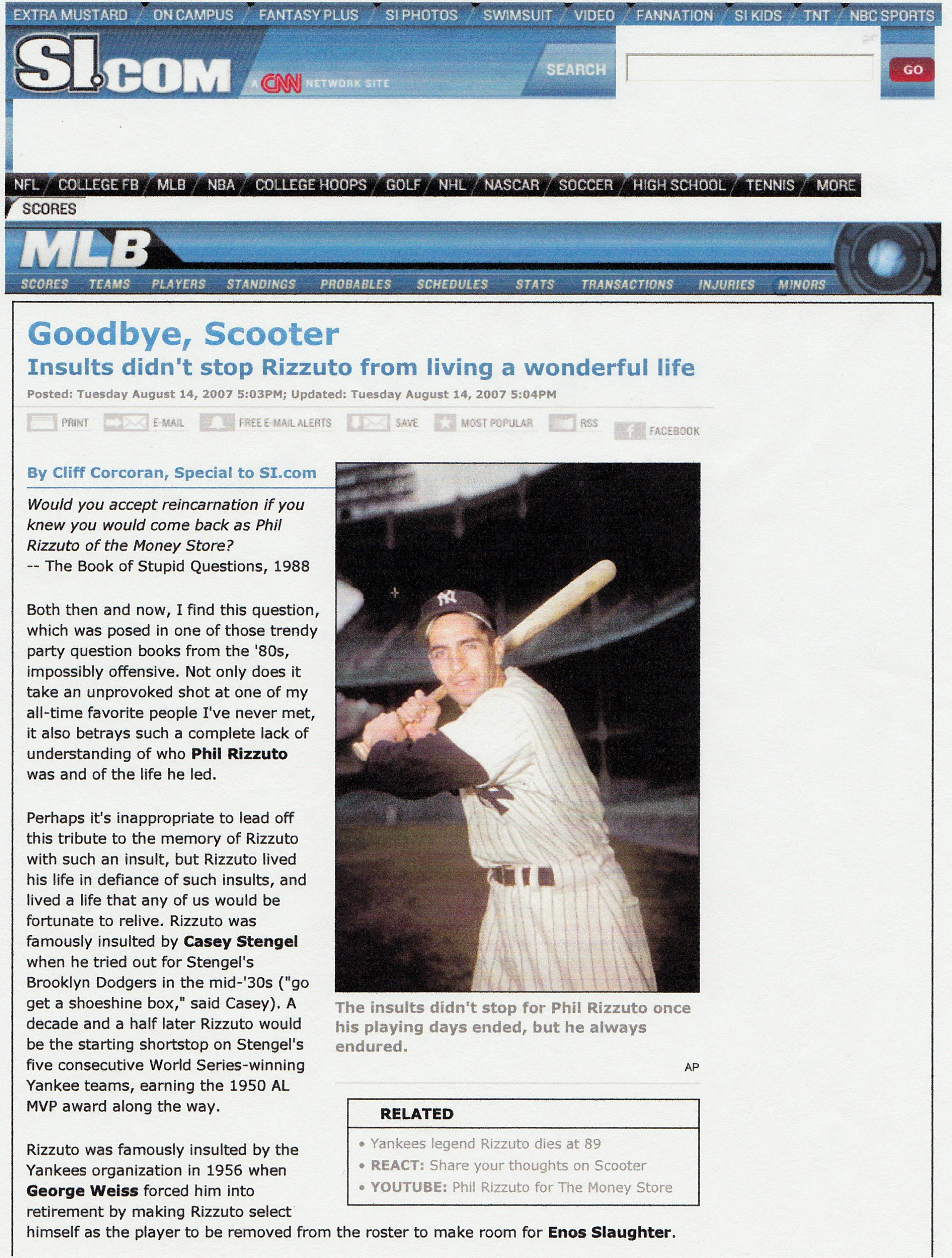
My first opportunity to break out of the Fungoes box with SI.com came with the news of Phil Rizzuto’s death on August 14, 2007. Though I had already been writing the Wild Card entry in the Fungoes blog for SI for five months at that point, I still think of this as my first proper SI.com piece, not because of the quality of the content, but because it was the first time my work for the site appeared on the standard SI.com template (see image below for a reminder of what the site looked like back then) and was rewarded with a proper freelance fee (we were paid for Fungoes, of course, but a relative pittance). Looking back at it now, it’s not a particularly strong piece, but it established my ability to provide quality work quickly on deadline in reaction to breaking news and likely did more to create my subsequent opportunities at SI.com than the previous four and a half months of Fungoes pieces combined. The piece has since vanished from the interwebs along with most of my other SI pieces from that year, but I’m republishing it below exactly as it appeared on SI.com in August 2007, warts and all.

SI.com template, August 2007

By Cliff Corcoran, Special to SI.com

“Would you accept reincarnation if you knew you would come back as Phil Rizzuto of the Money Store?”

–The Book of Stupid Questions, 1988

Both then and now, I find the question, which was posed in one of those trendy party question books from the ’80s, impossibly offensive. Not only does it take an unprovoked shot at one of my all-time favorite people I’ve never met, it also betrays such a complete lack of understanding of who Phil Rizzuto was and of the life he led.

Perhaps it’s inappropriate to lead off this tribute to the memory of Rizzuto with such an insult, but Rizzuto lived his life in defiance of such insults, and lived a life any one of us would be fortunate to relive. Rizzuto was famously insulted by Casey Stengel when he tried out for Stengel’s Brooklyn Dodgers in the mid-’30s (“go get a shoeshine box,” said Casey). A decade and a half later Rizzuto would be the starting shortstop on Stengel’s five consecutive World Series-winning Yankee teams, earning the 1950 AL MVP along the way.

Rizzuto was famously insulted by the Yankees organization in 1956 when George Weiss forced him into retirement by making Rizzuto select himself as the player to be removed from the roster to make room for Enos Slaughter. Weiss was slaughtered in the press for the move and the team’s broadcast sponsor insisted that Rizzuto be hired to broadcast the team’s games the following season. Rizzuto was still in the same job 39 years later when the team forced him to call a game rather than attend Mickey Mantle’s funeral. Rizzuto, enraged and embarrassed, quit mid-game, but public outcry brought him back for a 40th and final season.

My voice was one of those calling Rizzuto back. The Scooter may have had more to do with my becoming a baseball fan than anyone else. Though my family is filled with Yankees fans dating back to the days of Babe Ruth, I had no older sibling to turn me on to baseball and neither of my parents was particularly interested in professional sports when I was growing up. Instead it was Rizzuto, with his enthusiasm, good humor and wildly entertaining and unpredictable asides (which were a good match for the often tragicomic play of the mid-’80s Yankees), who sold me on the joys of the game and its history despite the poor quality of the team I was watching.

Even then I was aware of the slights Rizzuto had endured. In 1984 Pee-Wee Reese was selected to the Hall of Fame by the Veterans Committee, leaving Rizzuto on the outside looking in at his former crosstown rival. A decade later Rizzuto was finally inducted as well, only to have Bill James devote a large portion of his book The Politics of Glory to bemoaning Rizzuto’s selection. Though James ends his book by stating clearly that Rizzuto was “certainly not the worst player to stand on that podium,” many glossed over that line and dubbed Rizzuto precisely that (including the charming fellow who sponsors Rizzuto’s page on basebaballreference.com). It’s true that Rizzuto was inducted ahead of many far more deserving players, many of whom continue to await their day in Cooperstown, and that his induction has as much to do with a well-stocked veterans committee, led by Ted Williams (who often said that Rizzuto was the difference between the Yankees and Red Sox in the late ‘40s and early ‘50s). It’s also true that Rizzuto is far from the worst player in the Hall. Just look at the list of old cronies Frankie Frisch and Bill Terry helped through the door via the Veterans Committee in the early 1970s. The fact remains that, whereas Terry and Frisch were lining up former teammates, Rizzuto was inducted because the greats of the game, Williams and Ty Cobb among them, thought he deserved to be listed as one of their equals.

Unlike Williams or Cobb, Rizzuto was a hard man not to like. Though he held a grudge against Stengel’s shoeshine box comment throughout his life, and retired from broadcasting over Mantle funeral incident, I’ve never seen nor heard an unflattering word about the man. Whether you marveled at his wizardry in the field as a fan, cursed his pesky presence in the batters box or on the bases, laughed with him or at him while listening to a Yankees broadcast, or only knew him as the (reportedly unwittingly) double-entendre-spouting play-by-play announcer in the middle of Meat Loaf’s Paradise by the Dashboard Light, he brought good spirit to and evoked admiration from all those whose lives were touched by his.

It wasn’t such a bad thing to be Phil Rizzuto, Hall of Famer, seven-time World Series champ, MVP, All-Star, a man who spent a half-century in baseball interrupted only by his naval service during World War II. It’s no wonder Rizzuto endured all of those slights with such good humor. Beyond his accomplishments on the field and in the booth, Rizzuto enjoyed more than 60 years of marriage to his beautiful bride Cora (who was a frequent character in his broadcast banter), and is survived by three children and two grandchildren. We should all be so lucky to live the life Phil Rizzuto lived, but we are already very fortunate that he lived it. Rest in peace, Scooter.

Cliff Corcoran is the co-author of Bronx Banter.


Tags: , , , , , , , , , , , , , , , , , ,

Deleted Scenes: The 2010 NL Rookie Class

The following was published on SI.com on November 14, 2010 under the headline “NL rookie class unusually deep, talented.” It is one of several of my older articles that was lost in the site’s redesign in June 2014. I’m republishing it here, unaltered, from my original submission, prior to any editing by SI.com’s editors. Italicized sections below are from the original text.

In writing my Awards Watch column this season, I often found myself struggling to find five, or even three worthy players to round out my list of American League Rookie of the Year candidates. That stood in stark contrast to the crop of rookies in the National League, which not only provided stiff competition for my top five spots, but was large and diverse enough that one could assemble a strong 25-man roster from this year’s National League rookies alone. With the Rookie of the Year awards due to be announced on Monday, that got me thinking. What would that 25-man roster of NL rookies look like and, if assembled, how well could it have done in this year’s standings?

To answer that question, I have to set out some ground rules. First, I’m looking for a team that could play a full season, not an All-Star game. Thus, I’ll need my position players to total 162 games played at each position, my starting pitchers to total 162 games started, and my bullpen to add enough relief innings to combine with my starters to give me a total of 1,458 innings on the season (nine innings times 162 games). In order to reach those totals, I’ll likely have to expand my roster beyond 25 men, but no team uses just 25 men over the course of an entire season, so this remains within the realm of reality.

With regard to position, I will give myself a bit of flexibility. For example, though Buster Posey started 30 games at first base this year, I will count all of his games toward my catchers, and if an outfielder has experience in a pasture other than his usual one, or an infielder has experience at a relatable position (a third baseman who has played first, a shortstop who has played second or third, etc.), I’ll give myself permission to use that player to fill in the necessary games at those positions as needed. I will not use starting pitchers in my bullpen unless they have actually thrown those innings in relief, and vice versa for relievers starting. However, if a pitcher has both started and relieved this season, if I include him his starts will count toward my rotation and his relief innings will count toward my bullpen. I won’t attempt to isolate his performance in either role.

With that established, I need a total-production metric to allow me to measure the performance of my roster relative to an existing standard. Joe Posnanski examined some of the issues with the two different versions of WAR (Wins Above Replacement) earlier this season. I share his belief that FanGraphs’ WAR weighs defense more heavily, which I find problematic given how inexact even advanced fielding metrics are relative to our ability to parse out value from pitching and hitting. I also find FanGraphs’ WAR problematic because it uses Ultimate Zone Rating (UZR) for its defensive component, but UZR doesn’t rate catchers and doesn’t take into account several key aspects of paying first base. Baseball-Reference’s WAR uses Total Zone Runs for its defensive component, which at minimum has the advantage over UZR of rating catchers and seems to be more gently applied to the overall WAR stat. Baseball Prospectus’s VORP is an offense-only statistic, but it’s counterpart WARP (Wins Above Replacement Player, which pre-dates WAR by roughly a decade) not only includes fielding, but its fielding component, Fielding Runs Above Average, was overhauled last year to employ play-by-play data, giving new life an old favorite. I’ll stick with the dame I came in with and use WARP.

For players with more than the required amount of games played, I will use a pro-rated portion of their total WARP. Those partial-season statistics are in italics below.

Here, then, is my 2010 National League All-Rookie team:

1B – Ike Davis, Marlins (147 G, 3.1 WARP)
2B – Neil Walker, Pirates (110 G, 2.1 WARP)
SS – Starlin Castro, Cubs (125 G, 2.4 WARP)
3B – Chris Johnson, Astros (92 G, 1.96 WARP)
C – Buster Posey, Giants (108 G, 4.4 WARP)
RF – Jason Heyward, Braves (142 G, 5.1 WARP)
CF – Jose Tabata, Pirates (102 G, 2.7 WARP)
LF – Mike Stanton, Marlins (100 G, 2.5 WARP)

Bench:

1B – Gaby Sanchez, Marlins (15 G, 0.21 WARP)
SS/2B – Ian Desmond, Nationals (89 G, 1.10 WARP)
3B – David Freese, Cardinals (70 G, 2.2 WARP)
LF – Logan Morrison, Marlins (62 G, 1.5 WARP)
CF – Lorenzo Cain, Brewers (43 G, 1.1 WARP)
RF/CF – Chris Heisey, Reds (37 G, 0.42 WARP)
C – Josh Thole, Mets (54 G, 1.55 WARP)

Rotation:

Jaime Garcia, LHP, Cardinals (28 GS, 4.0 WARP)
Jhoulys Chacin, RHP, Rockies (21 GS, 2.8 WARP*)
Madison Bumgarner, LHP, Giants (18 GS, 2.9 WARP)
Barry Enright, RHP, Diamondbacks (17 GS, 2.6 WARP)
Dan Hudson, LHP, Diamondbacks (11 GS, 3.6 WARP)

Travis Wood, LHP, Reds (17 GS, 1.7 WARP)
Alejandro Sanabia, RHP, Marlins (12 GS, 1.4 WARP*)
Casey Coleman, RHP, Cubs (8 GS, 1.2 WARP*)
Dillon Gee, RHP, Mets (5 GS, 1.2 WARP)

Bullpen:

John Axford, CL, Brewers (58 IP, 4.1 WARP)
Jonny Venters, LHP, Braves (83 IP, 2.2 WARP)
Wilton Lopez, RHP, Astros (67 IP, 2.3 WARP)
Ryan Webb, RHP, Padres (59 IP, 1.3 WARP)
Drew Storen, RHP, Nationals (55, 1.5 WARP)
Ernesto Frieri, RHP, Padres (31 2/3 IP, 0.9 WARP)
Kenley Jansen, RHP, Dodgers (27 IP, 1.4 WARP)
Craig Kimbrel, RHP, Braves (20 2/3 IP, 1.7 WARP)
Michael Dunn, LHP, Braves (11 1/2 IP, 0.48 WARP)
Hisanori Takahashi, LHP, Mets (12 GS, 122 IP, 2.7 WARP*)

DL:

Stephen Strasburg, RHP, Nationals (12 GS, 1.6 WARP)

*WARP includes relief innings, which are factored into overall team innings

That’s 35 players, fewer than any of the 30 major league teams used during the 2010 season (the Rays came closest, using just 37 men, 35 of whom appeared in at least ten games). Though I have a nice mix of righties and lefties on my pitching staff, the offense is heavily right-handed. Only Heyward, Davis, and bench players Morrison and Thole bat lefty, while Walker is the only switch-hitter. Not that I mind. Want a batting order? How’s this:

R – Jose Tabata (.299/.346/.400, 19 SB)
R – Starlin Castro (.300/.347/.408, 10 SB)
L – Jason Heyward (.277/.393/.456, 18 HR)
R – Buster Posey (.305/.357/.505, 18 HR)
L – Ike Davis (.264/.351/.440, 19 HR)
R – Mike Stanton (.259/.326/.507, 22 HR)
R – Chris Johnson (.308/.337/.481, 11 HR)
S – Neil Walker (.296/.349/.462, 12 HR)

WARP, again, is Wins Above Replacement Player. Replacement level is defined as the production that can be expected from a freely available player, be it a non-prospect promoted from Triple-A or a player placed on waivers or released by another team. A replacement level team is thus, essentially, the worst major league team possible. The worst major league team in the modern era was the 1916 Philadelphia A’s, who had a .235 “winning” percentage. That translates to 38 wins over a 162-game schedule. According to Baseball Prospectus’s definition of WARP, a team that is replacement level across the board would likely win no more than 25 games. I can thus use that 25 wins as the starting point for my team, adding the total WARP from my roster above to figure out just how many games this team might have won.

Adding up the 35 WARP totals above, I find my NL All-Rookie team was 73.92 wins above replacement in 2010. If you add those 74 wins to the 25-win baseline you’ll find the team above, comprised exclusively of National League rookies, would have won 99 games, more than any other team in baseball in 2010.

So how deep was the 2010 National League rookie class? So deep you could not only assemble an entire 25-man roster (with ten alternates) of NL rookies, but future stars such as Pirates third baseman Pedro Alvarez, Phillies outfielder Domonic Brown, Reds righty Mike Leake, and Mets hurlers Jenrry Mejia and Jonathon Niese didn’t even make the team, nor did hot-hitting rookies Tyler Colvin of the Cubs or Jon Jay of the Cardinals (all had inferior WARP-per-game rates to the players listed in their positions above). It was so deep that it could absorb Stephen Strasburg’s elbow injury and still have a deep and effective rotation. So deep that the resulting roster would have had the best record in the major leagues in 2010, won any division in the game, and had home-field advantage throughout the playoffs. That deep.

Thanks to Baseball Prospectus’s Colin Wyers for filling me in on the finer points and current formulation of WARP.


Tags: , , , , , , , , , , , , , , , , , , , , , , , , , , , , , , , , , , , , , , , , , , , ,

Deleted Scenes: Anticipating Barry Bonds’ all-time home run record

The following was published on SI.com on May 18, 2007 as part of the site’s short-lived Fungoes blog for which I wrote the Friday “Wild Card” entries. It is one of several of my older articles that was lost in the site’s redesign in June 2014. I’m republishing it here, unaltered, from my original submission, prior to any editing by SI.com’s editors.

Last Tuesday, Barry Bonds hit a solo home run off Tom Glavine for the only Giants’ run in a 4-1 loss to the Mets. That home run put him exactly ten behind Hank Aaron’s career home run record of 755. Since then, Bonds has gone just 2 for 16 (a single and a double), but walked nine times. Still, it’s now all but inevitable that Bonds, who entered the season 21 homers shy of Aaron, will break Aaron’s record this season.

The thought of the surly, unlikable Bonds, who allegedly used illicit means to get into this position, breaking the record the gentlemanly, heroic Aaron claimed in the face of intense racial hatred conjures up a wide variety of unpleasant reactions in nearly every baseball fan. Most fans, consciously or not, still think of Roger Maris’s 61 home runs, not Bonds’s 73, as the single-season record. I don’t have the time, space, or energy to get into the legitimacy of Bonds’s accomplishments right now, but it seems as though the closer Bonds comes to Hank’s 755, the more the mind races for ways to defang, if not outright undermine his accomplishment.

This all got me thinking about the nature of sports records in general. When Maris was bearing down on Babe Ruth’s single-season mark of 60 home runs in 1961, there was a similar recoiling by baseball purists who hadn’t anticipated Ruth’s homer marks ever being broken, and certainly not by a flash-in-the-pan such as Maris. As Maris neared the record, then-Commissioner Ford Frick, who was once Ruth’s ghostwriter, famously declared that Maris, who was chasing Ruth in the first year of expansion for which the season had been extended from 154 games to 162, would have to break Ruth’s record by the Yankees’ 154th game or suffer the cruel indignity of having his mark listed separately as the “162-game record” (no, Virginia, there never was an asterisk, now go tell Billy Crystal). Maris had just 58 homers after 154 games and thus his record, which is now considered the “pure” record, was listed separately until Fricks’ distinction was abandoned in 1991.

History (and Crystal) vilified Frick for that decision, but here’s the thing: statistically speaking, Frick was right. Ruth hit 60 home runs in a 154-game season and Maris hit just 58 in a 154-game season, then, given an extra eight games, hit three more. If the point of the single-season home run record was to honor the player who could hit the most home runs in a limited number of opportunities, Frick’s method was the right one. Of course, if that was the point, the record would belong to Bill Lefebvre, who, as a rookie pitcher for the Red Sox in 1938, hit a home run in his only plate appearance of the season. Need a larger sample? What about outfielder Ed Sanicki, who hit three home runs in 15 plate appearances for the Phillies in 1949? Or Ted Williams, who hit 13 homers in 110 plate appearances (8.46 PA/HR) after returning from Korea in 1953. Heck, if Frick was so interested in honoring home run frequency, he should have shifted the record from Ruth’s 60 in 1927 (11.52 PA/HR) to Ruth’s 59 in 1920 (10.42 PA/HR).

Of course, that’s not the point of the single-season home run record. The point isn’t how often, it’s how many. Cumulative records such as the single-season and career home run records are more primal than rate-based records such as batting average or ERA. Quick, who holds the single-season batting average record? Come on, this was the single statistic that was used to compare hitters for nearly all of the twentieth century. When a hitter leads the league in batting average, he’s not called the “batting average leader,” he’s the winner of the batting crown, he leads the league in hitting. Being a .300 hitter is supposed to say something fundamental about a player’s ability, if not their character. Got an answer yet? Is it Hugh Duffy’s .440 in 1894 or Nap Lajoie’s “modern” record of .427 in 1901? What’s the minimum number of plate-appearances required for this record anyway?

See what I mean? That’s not “most,” that’s math. The home run record is most, and the man who hit the most home runs in a single season as of October 1961 was Roger Maris. It didn’t matter that he had more chances than Ruth, the fact was no man had ever hit 61 home runs in a single season of any length, it had never been done. That’s what a record is, something that’s never been done. When Mark McGwire hit 70 in 1998, that had never been done, and if say you weren’t as awed by McGwire’s total as he was by himself, you’re probably lying.

Barry Bonds broke McGwire’s single-season record in 2001 and, though by then the baseball world had become jaded by allegations of steroid use and by the onslaught of 60-plus home run seasons (Bonds’ was the fifth in four years and Sammy Sosa would make it six that same year), no one had ever hit 73 home runs in a single baseball season before Bonds did it that year, and no one has done it since. That’s the definition of a record.

I remember watching the 1988 Summer Olympics in Los Angeles when I was a kid and seeing Ben Johnson run 100 meters in 9.79 seconds. No man had ever been recorded traversing that distance in so short a time in the entirety of human history. Three days later, it was revealed that Johnson had tested positive for the steroid Stanozolol. Johnson was stripped of his gold medal in light of his positive test, which I understood, but he was also stripped of his world record, which I didn’t. I understood that he had cheated, but the simple fact was that no man had ever been clocked running 100 meters in less time. How could the Olympic Committee pretend that had never happened? It’s one thing to disqualify a boxer from a fight, or a player or team from a game, but a sheer physical accomplishment like that could never be disqualified in my mind.

So sometime in the next month or two, Barry Bonds will hit his 756th career home run, and there will be much pulling of hair, gnashing of teeth, rending of garments, and crunching of numbers, but the simple fact will be that no man has ever hit 756 regular season home runs in the major leagues, ever, and that, despite the taint and dishonor that Bonds may bring along with him to that summit, is a record.


Tags: , , , , , , , , , , , , , , , ,

Deleted Scenes: Crunching the numbers on A-Rod’s initial PED confession

The following was originally published on SI.com on February 13, 2009 under the headline “Was it the PEDs or the Park? A look inside A-Rod’s Texas numbers.” It is one of several of my older articles that was lost in the site’s redesign in June 2014. I’m republishing it here, unaltered, from my original submission, prior to any editing by SI.com’s editors. Given that this is an incendiary topic, I want to point out here that the intention of this article wasn’t (and isn’t) to absolve Rodriguez of wrongdoing, he’s very clearly guilty of extensive performance-enhancing drug use, but to attempt to discern how much, if at all, that drug use aided his performance on the field.

While others debate the sincerity and completeness of Alex Rodriguez’s confession to Peter Gammons on Monday, let’s push past the he said/she said between Rodriguez and Selena Roberts, past the garment-rending over the impact of his drug use upon the history and integrity of the game, and past the love/hate relationship baseball fans have with Rodriguez, a superstar bizarrely burdened with intense insecurities. Instead, let’s take a cold, hard look at the seasons during which Rodriguez admitted he had experimented with banned substances to see what impact, if any, those substances had on his performance on the field.

If we take Rodriguez at his word, his three years as a Texas Ranger from 2001 to 2003, were the only seasons during which he used illegal performance-enhancing drugs. In those three seasons, he hit 156 home runs. By comparison, in his last three seasons with the Mariners, from 1998 to 2000, he hit 125 and in his first three seasons with the Yankees, from 2004 to 2006, he hit 119. In those six bookend seasons, he surpassed 42 homers just once, but in his three seasons in Texas he hit 47 or more every year.

So yes, Alex Rodriguez hit more home runs when he was juicing, but was it because he got his power from a pill, or were there other factors at work? Consider the fact that Rodriguez missed just one game in his three years with Texas, playing in 485 of the Rangers’ 486 games over that span. In his first three seasons with the Yankees, he played in 14 fewer. In his last three seasons with the Mariners, he played in 47 fewer. Rodriguez told Gammons on Monday that a large part of his motivation for experimenting with banned substances was his desire to be able to play every day through the hot Texan summers. In helping him achieve that goal, the drugs clearly worked.

The question then becomes, to what degree did Rodriguez’s ill-gotten ability to play every day contribute to the surge in his power numbers. Consider his home runs rates in each of the three-year spans mentioned above (expressed as plate appearances per home run):

  • SEA ’98-00: 15.94 PA/HR
  • TEX ’01-03: 13.92 PA/HR
  • NY ’04-’06: 17.54 PA/HR

Those figures tell us that, not only did Rodriguez take the field more often during his three drug years than in the three-year periods immediately before and after, but he also went deep more often, homering more often than once every 14 plate appearances during his time in Texas. Yet, while there’s a strong correlation between Rodriguez’s drug use and playing time, the source of Rodriguez’s power surge lies elsewhere.

Safeco Park, which Rodriguez’s Mariners moved into in mid 1999, is a pitchers park, as was the remodeled Yankee Stadium, the latter of which was particularly hard on right-handed power hitters such as Rodriguez. The Ballpark at Arlington, on the other hand, is a launching pad. Factor in a year and a half of play at the similarly homer-happy Kingdome in 1998 and 1999, and those home run rates above would seem to correspond to park factors as much or more than to drug use.

To get rid of the effects of his home parks, let’s take a second look at Rodriguez’s home run rates using only his performance on the road during each of those three-year spans:

  • SEA ’98-00: 13.61 PA/HR
  • TEX ’01-’03: 14.76 PA/HR
  • NY ’04-’06: 18.68 PA/HR

Here we see that Rodriguez was a better home-run hitter on the road during his last three “clean” seasons with the Mariners than he was during his three drug years with the Rangers. Those two periods offer a particularly strong comparison because Rodriguez spent all six years in the AL West. Thus, save for moving roughly 12 percent of his road games (10 of 81 annually) from Texas (as a visiting Mariner) to Seattle (as a visiting Ranger), his road games were played in essentially identical environments.

Rodriguez went deep on the road approximately 8 percent less often as a Ranger while playing 12 percent of his road games in a less friendly home-run environment. Given that his Ranger years coincided with his peak-age years (ages 25 to 27), during which an increase in power would have been expected even without the help of illegal substances or a friendlier home park, it’s difficult to attribute any of his overall increase in power during those years to the drugs.

In fact, glancing back at those road rates above, there’s a superficial appearance of a power decline beginning, not with his first “clean” season in New York in 2004, but with his arrival in Texas in 2001, which is when Rodriguez claimed he started using performance-enhancers. That decline may be superficial in the above numbers, but in reality it ran much deeper, as I first reported in an analysis I did of Rodriguez’s career trends for Bronx Banter following the 2004 season. That piece centered around what I referred to as, “a minor, but still unsettling downward trend in Rodriguez’s offensive numbers” that “began with Alex’s first season in Texas in 2001, but was disguised by his move from the pitcher-friendly Safeco Park . . . to the [hitter-friendly] Ballpark at Arlington.”

I detected this trend—which began with Rodriguez’s age-24 season in 2000, his last with the Mariners, continued through his three seasons in Texas, and concluded with his first season as a Yankee in 2004—in several park-adjusted, total-offense rate stats, including Baseball Prospectus’s Equivalent Average (EqA), Baseball-Reference’s adjusted OPS (OPS+), and Bill James’ Offensive Winning Percentage (OWP). Consider the following progression from 2000 to 2004, with Rodriguez’s three Texas seasons in bold:

EQA: .343, .331, .322, .320, .309
OPS+: 167, 164, 152, 148, 133
OWP: .770, .749, .705, .697, .654

I could have listed other stats that exhibit the same trend, both adjusted and non-adjusted (WARP, Runs Created, Runs Created Against Average, Runs Created Per Game, unadjusted OPS, Gross Production Average, etc.), but there was no need. The trend was real and four years running.

That analysis of Rodriguez’s performance trends was untainted by any knowledge or suspicion of his drug use while with the Rangers and, just as I have now done four years hence, wrote off the apparent surge in Rodriguez’s numbers while in Texas as park-driven while digging beneath those gaudy counting stats to reveal a modest decline in his overall production during his three years in Texas.

Since joining the Yankees, Rodriguez has enjoyed the two best seasons of his career, both of which supposedly came without the aid of performance-enhancing drugs. Consider how his MVP seasons of 2005 and 2007 compare with the five seasons listed above:

  2005 2007
EQA .351 .353
OPS+ 173 177
OWP .787 .780

Put this all together, and it’s clear that, if he is indeed telling the truth about his drug use being limited to his three years in Texas, the only noticeable benefit Alex Rodriguez derived from his experimentations with banned substances was his ability to play 485 of the Rangers’ 486 games during his three years with the club. That’s no small thing. There are some who believe that the must undervalued statistic in baseball is games played. It’s irrefutable that Rodriguez’s ability to take the field every day as a Ranger enabled him to put up the remarkable counting stats he compiled in a Texas uniform, chief among them his 57 home runs in 2002. Still, there’s no evidence that the drugs made him any more powerful, and significant evidence that his rate of production actually declined during his doping years.

Rather, it was the ballpark, not the drugs, that seems to have been the key to Rodriguez’s statistical surge (34 of his 57 homers in 2002 came in Arlington where he homered once every 10.6 PA vs. once every 15.7 PA on the road in 2002). Whether or not that’s enough to convince anyone, myself included, that his statistics remain “untainted” is, unfortunately, another matter entirely and one far less likely to be settled in Rodriguez’s favor.


Tags: , , , ,

Postseason Coverage: Saturday, Oct. 6, 2012

I have five pieces up on SI.com today, so rather than send out five tweets about them, I thought I’d put the five links here for one-stop shopping. They are:

Enjoy!


Tags: , , , , , , , , , , , , , , , , , ,